Ten commandments for parents of preschoolers
Entering the first grade of elementary school represents a major life change for a child. The child's role, environment, adults and peers, daily schedule, activities, and expectations all change. In order for a child to handle this challenging situation without serious problems, they should be not only sufficiently developmentally and socially mature, but also well-prepared. It is important to keep in mind that a child's maturation is uneven, and that not every child will reach every parameter, but they can approach them. The greater the degree of mastery of the required parameters, the greater the likelihood of success in the first grade.
In 2025, major changes occurred in the concept of preschool and primary education, and the standards for preschool education and expected preschool learning outcomes (what a child should master before entering first grade) were changed.
The vision of what it means for a "child to be ready for elementary school" has changed. Priority emphasis is no longer placed on academic knowledge within the framework of readiness for the first grade. According to the new FEP PE 2025, it is important that the child is prepared to function as a future student – meaning in the areas of independence, communication, thinking, and relationships. It is not about the child knowing how to read, write, or count, but rather that they:
- are ready for the school routine
- knows how to function among others
- is curious and independent
In other words: “ready to learn,” not “already taught.”
The Ministry of Education has prepared a document designed to help parents, in cooperation with the preschool, prepare their children for the start of first grade. This document replaces the well-known "Ten Commandments for the Preschooler."
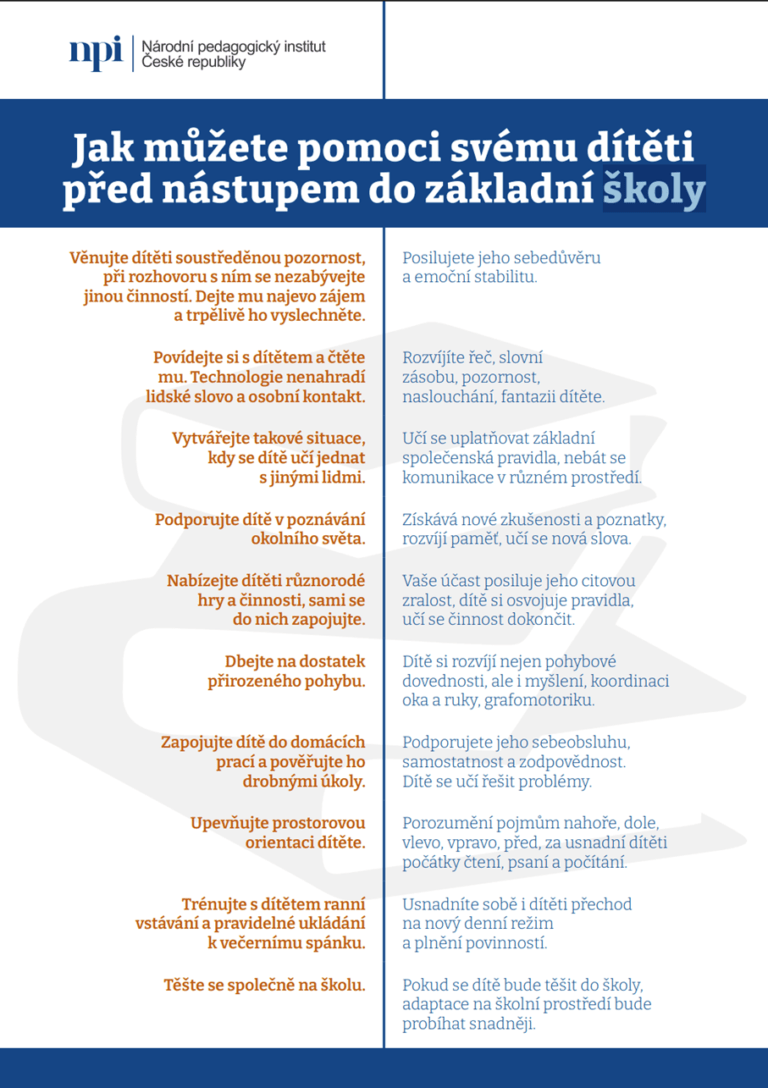
So, what should our preschoolers be able to do?
So we already know that a child should be mature enough for the school routine, able to function among people, and be curious and independent. But how can this be achieved? How can you help your child? We have prepared a small checklist for you to help you navigate the issue and offer a more specific idea of what your preschooler could manage by the end of their preschool attendance.
- Psychological and social readiness
- stays focused on a task (for approx. 10–15 minutes)
- respects rules and authority (teacher)
- is able to wait and take turns
- cooperates with other children
- is able to manage separation from parents
It is important to emphasize independence and responsibility for one's own learning
- Communication and speech
- speaks intelligibly (pronounces most sounds correctly)
- able to tell a simple story
- understands instructions (even more complex ones)
- is able to ask questions or ask for help
- Graphomotor skills and fine motor skills
- holds a pencil correctly
- is able to draw basic shapes
- can imitate simple shapes
- cuts with scissors, handles small objects
- Gross motor skills
- runs, jumps, climbs
- coordination of movements (e.g., catching a ball, jumping over a low obstacle)
- basic self-care (dressing, hygiene)
- Pre-mathematical concepts
- distinguishes between more/less, the same
- counts roughly to 5–10
- is oriented in space (up/down, right/left)
- sorts by color, shape, and size (even by multiple criteria at once)
- Pre-reading skills
- recognizes some letters (this does not mean they are learning to read!)
- recognizes their own name
- perceives rhymes, syllables
- distinguishes sounds within a word
- identifies the first sound in a word
- Orientation in the world
- knows their name and age
- knows where they live
- is oriented in common situations (preschool, family)
- basic safety (e.g., strangers, the road)
It is necessary to focus on handling common and extraordinary situations (safety)
- Self-care and independence
- dresses themselves, puts on shoes
- eats independently, tidies up their things
- manages hygiene
- completes simple tasks